


CIA's Secret : How Peter Thiel built a 200 Billion dollar Weapon for America?
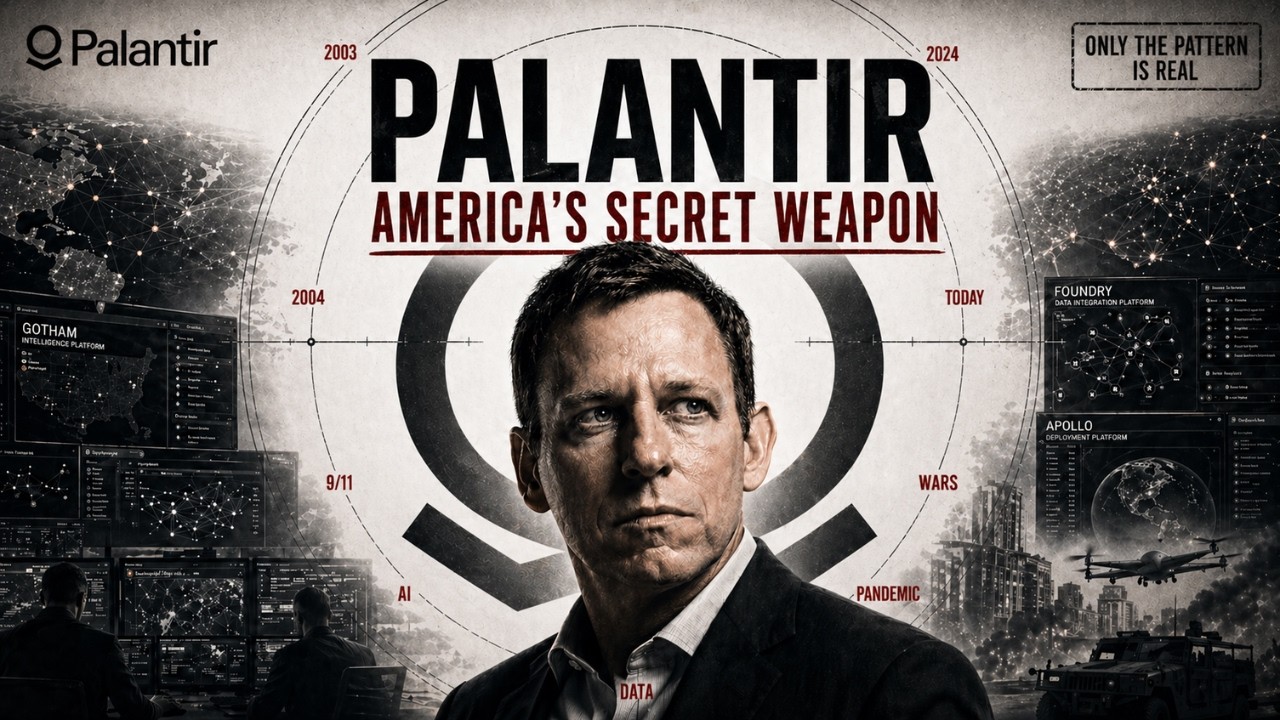
The 9/11 Commission called it a failure of imagination: the CIA, FBI and NSA each held pieces of the plot - flight school records, wire transfers, watchlist names - but their computers could not talk to each other. This case study traces how Peter Thiel turned that failure into Palantir, a company with no product, no clients and $30 million of his own money, now worth $350 billion with its software inside the CIA. The story runs from PayPal's fraud war - bleeding $10 million a month to Russian hackers until Max Levchin's Igor software let human analysts see criminal rings instead of rules - to the disastrous first CIA demo, the invention of the forward deployed engineer, Gotham's IED pattern-finding in Iraq and Afghanistan (the 82nd Airborne reported a 12% jump in finding roadside bombs), and the reported role of Gotham in the decade-long hunt for Osama bin Laden. Important attribution note: Palantir and the CIA have never confirmed the bin Laden connection; the video itself cites press reports, and all claims and figures here are the video's own. FULL COVERAGE: the captions appear to cover the entire episode. Sponsor: Wested (mid-video ad); Perplexity Computer is also promoted inside the lessons. Nothing here is investment advice.
Executive Summary (TL;DR)
Palantir's origin is one idea applied twice. At PayPal, rule-based fraud systems lost a chess match to adaptive Russian hackers until Max Levchin flipped the model: software (Igor) that visualized connections and flagged the weird 20 transactions out of 10 million, while humans made the calls - fraud losses fell 70%. After 9/11, Thiel saw the same shape in America's spy agencies: all the data, no shared picture. Rejected by every VC, he funded Palantir himself, bought credibility with a $2 million In-Q-Tel check, survived a failed first CIA demo by inventing the forward deployed engineer - engineers coding inside Langley beside analysts - and won the wars: Gotham mapped IED networks in Iraq and Afghanistan and, per press reports (never officially confirmed), traced bin Laden's courier through 3 million diplomatic telegrams, 170,000 satellite images and 8,000 hours of calls, cutting a 72-hour money-trail analysis to 12 minutes. The three stealable lessons: build software that makes humans superhuman rather than replacing them; sit next to your customer because the strength of your business is inversely proportional to that distance; and chase the legendary client, not the biggest check. FULL COVERAGE: captions appear complete. Sponsor: Wested. Not investment advice.